Nutritional manipulations for training. Part 4 of 6:
Does a low-carb diet improve endurance performance?
Thomas Solomon PhD.
12th Dec 2020.
Last time, I took you on a journey through the 100-year research history that has shaped our knowledge concerning the effects of low-carb/high-fat diets on exercise performance. But I didn’t conclude the story; I left you with an important question: “does a low-carb/high-fat diet offer a performance advantage to an endurance athlete?”. Stay with me as I begin to answer this complex question, which Liam Gallagher started singing about in the 90s...
Please retweet or share this article with anyone who will find it educational:
Reading time ~11-mins (2200-words).
Or listen to the Podcast version.
You might be surprised to find that it is among some immortal words echoing the Britpop scene of the late 90s where we will find some clarity in this never-ending story of the low-carb diet puzzle.
“Slowly walking down the hall. Faster than a cannonball.”
Back in 1996, I literally had no idea what Liam Gallagher was whining about. But now, I am sure he must have written those lyrics while coming off the back of a low-carb/high-fat diet bender…
Why do I say that?
Well, to bring clarity to this fatty mess, all it took was the best low-carbohydrate diet and exercise performance study to date.
The last 100-years of research teaches us that habituating to a low-carbohydrate diet decreases muscle glycogen levels while increasing fat oxidation rates during exercise and prolonging running and cycling time-to-exhaustion at low exercise intensities. But, knowing your “time to exhaustion” is not ideal since it does not simulate race performance. And, endurance races are generally not run at a low-intensity — you never line up to “give it medium”.
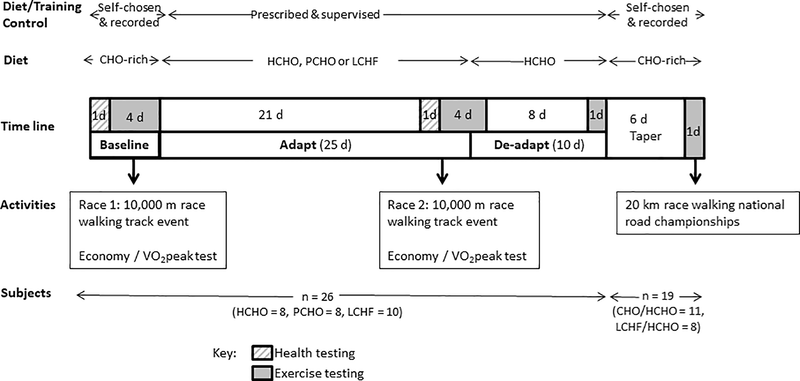
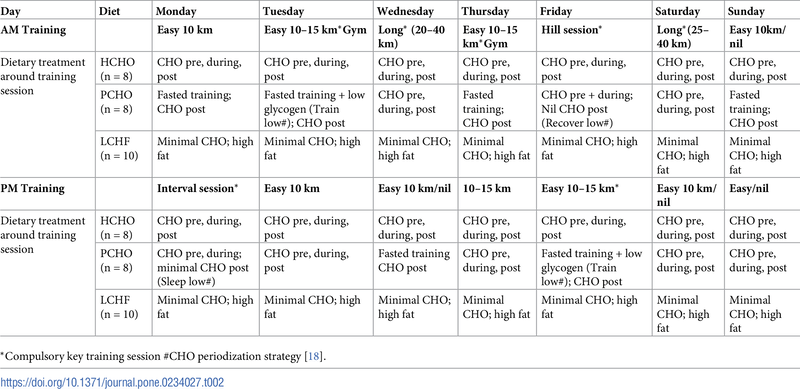
So, I concluded my last post by stating that to test the hypothesis that a low-carb/high-fat diet offers a performance advantage to an endurance athlete, we would need a well-controlled trial examining the effects of habituation to a low-carb vs. a high-carb diet on race performance in a large group of highly-trained endurance athletes. In 2016, Louise Burke and her team did just that — they invited world-class endurance athletes to join “in-patient” training camps at the Australian Institute of Sport for 3-weeks while intensively training and receiving either a low-carbohydrate ketogenic diet (less than 50 g/day, 2.1 g/kg/day of protein; identical to that used by Phinney et al. in 1983) or an energy-matched high-carbohydrate diet (8.6 g/kg/day of carbohydrate, 2.1 g/kg/day of protein). Before and after the 3-week interventions, athletes not only completed a 25 km bout to assess fat and carb oxidation rates and economy but they also competed in an official World Athletics-sanctioned 10 km race.
Contrary to some popular beliefs, good scientists like Burke are not out on an agenda-driven quest to sink keto as a dietary approach to improve performance. Some scientists are also practitioners, looking to optimize their athletes’ performance. In Burke’s case, she is a practitioner at the AIS trying to optimize the performance of Australian Olympians (or, at least she was until she left her role at the AIS a few months ago).
The bonkers comments can also get somewhat amusing at times. For example, “Phinney clearly showed that low-carb works” or, “Burke’s studies simply aren't long enough to cause fat-adaptation.”
Why is this amusing?
Well, because humans “fat adapt” rather rapidly to low-carb/high-fat feeding — we’ve known for 100-years that resting RER values (respiratory exchange ratios) drop within days of beginning a low-carb/high-fat diet, indicative of greater fat oxidation rates at rest. Furthermore, it seems that in the eyes of the “Burke haters”, Phinney’s and Volek’s studies and the suggested approaches outlined in their popular science book, The Art and Science of Low Carbohydrate Performance are long-enough to cause fat adaptation, but when Burke’s team use the exact same diet for the exact same time, their studies are too short to cause fat adaptation.
Potentially ruining Olympic medal hopes of a world-class athlete by randomising them to something potentially detrimental is not ideal. So, the Supernova study purposely recruited athletes who were genuinely interested in the dietary approaches being offered and allowed them to choose their dietary group allocation, providing the potential for their “belief” in the benefits of the intervention to play a role — this is the “placebo effect” and is something many athletes try to use to their advantage.
Neither a scientist, a practitioner, or an athlete, could not deny that Supernova is a well-designed and well-conducted study. It has limitations, yes. But, when a good scientist agrees there are some limitations with their work, and when their work’s conclusions have many nay-sayers, and when that same scientist has received a lot of hate, what would that scientist do?
They would nod their head, smile, and do it all again... Supernova 2.
As Alex Hutchinson so eloquently put it: “The most convincing way to refute Burke’s results isn’t to list all the things she might have done wrong; it’s to do it right, demonstrate the performance benefits, and publish the results. Better yet, do it twice.”
This time Burke’s team recruited 28 international race walking athletes to repeat the same approach as that used in Supernova 1. But, there was an important addition of a 20 km race at the National Road Championships approx 2-weeks after cessation of the study diet, during which time all athletes received a high-carbohydrate diet and tapered their training to “peak” for the race. The 20 km race results were compared between groups and against race times for the 10 km race by converting race times to their equivalent World Athletics points score.
But Supernova did not stop there… The study series is ongoing and its latest update (Supernova 4) is that keto-adaptation can occur rapidly in elite athletes — needing only 5-days of low-carbohydrate/high-fat diet to cause nutritional ketosis and elevate resting and during-exercise fat oxidation rates. But, just 5-days of low-carb ketogenic feeding reduced economy and 10km race performance, impairments that were not remedied with a single day of high-carb availability nor following a further 5-days of high-carb dietary intake despite returning muscle glycogen to baseline levels.
So, the Supernova data teach us that when a highly-trained athlete adapts to a low-carb diet they become less economical and they lose their speed during high-intensity racing. Furthermore, restoration of carbohydrate availability, even for as long as 2-weeks, does not restore impaired performance.
Does the “debate” stop there?
Nope. Now I am seeing folks proposing things like,
If a low-carb diet increases the oxygen cost of exercise, how can you remedy that?
A somewhat sensible question, given the indisputable evidence that low-carb diet habituation renders an athlete less economical. But the view that taking an economy-boosting dietary supplement like a ketone ester or beetroot to restore lost economy caused by a low-carb diet is, quite frankly, vastly over-complicating the issue.
Supplements might be the answer.
Or, rather than spending more money and “playing with fire”, a better solution to that problem is to simply choose not to jeopardise your running economy if you are looking to improve your high-intensity performance.
Furthermore, don’t distract yourself from the big things that will definitely improve your performance — phenomenal training plan design, careful training load monitoring, sleeping lots, and knowing when to rest. Also, take confidence in your new knowledge that
Experimental evidence proves the theory of bioenergetics.
If you’ve followed this series, you will know that theoretical bioenergetics demonstrate that
Glucose uses fewer litres of oxygen per gram than fatty acids,
Glucose produces more energy (ATP) per litre of oxygen, and
Glucose produces ATP at a faster rate than fatty acids.
Since that hypothesis has now been experimentally tested under race day conditions, we know that the logic of bioenergetics holds true. So, we know that using a low-carbohydrate diet to train with a chronically low carbohydrate availability:
Reduces your muscle glycogen levels and
Lowers your muscles’ ability to transport glucose into the mitochondria, therefore lowering your muscle’s ability to use glucose to produce ATP,
The consequence of which
Compromises the use of the energy substrate (glucose) that uses less oxygen to produce ATP.
Which is not useful because that then
Impairs your ability to rapidly produce ATP to fuel racing at a high fraction of your maximal aerobic capacity, i.e. when oxygen supply becomes limited.
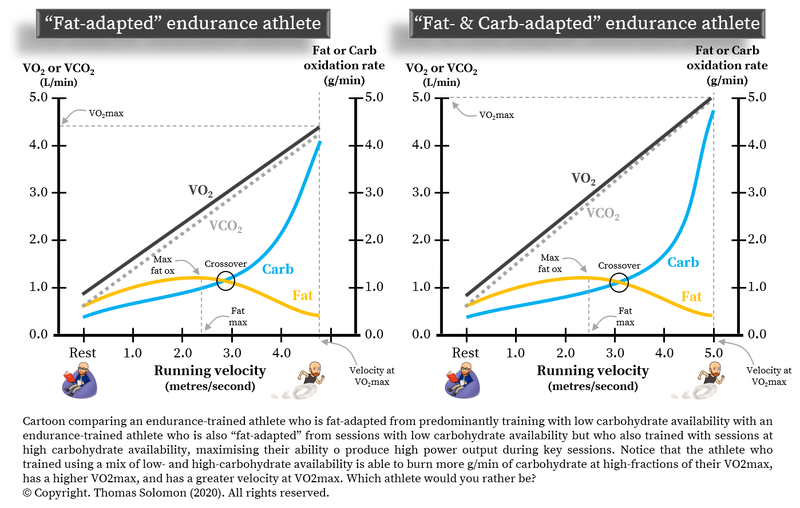
The bottom line is, don’t be the athlete on the start line with a high maximal fat oxidation rate and a high fat max but with a low maximal carbohydrate oxidation rate and low velocity at VO2max — train to spare glycogen AND to be able to use it when you need it... Combine the best of both worlds!
Sounds great. And perhaps Liam Gallagher's cryptic Champagne Supernova lyric becomes a little clearer, “Slowly walking down the hall. Faster than a cannonball.” …
I suspect his nonsense was about perspective and context, which is quite relevant because those things help us conceptualise the answer to the question that you might have been hoping I would answer:
For an endurance athlete, is a high-carb diet better than a low-carb diet?
A prudent question for an athlete to ask, an answer to which I will help you understand next time…
Until that time, keep training smart!
Disclaimer: I occasionally mention brands and products but it is important to know that I am not affiliated with, sponsored by, an ambassador for, or receiving advertisement royalties from any brands. I have conducted biomedical research for which I have received research money from publicly-funded national research councils and medical charities, and also from private companies, including Novo Nordisk Foundation, AstraZeneca, Amylin, A.P. Møller Foundation, and Augustinus Foundation. I’ve also consulted for Boost Treadmills and Gu Energy on their research and innovation grant applications and I’ve provided research and science writing services for Examine — some of my articles contain links to information provided by Examine but I do not receive any royalties or bonuses from those links. These companies had no control over the research design, data analysis, or publication outcomes of my work. Any recommendations I make are, and always will be, based on my own views and opinions shaped by the evidence available. My recommendations have never and will never be influenced by affiliations, sponsorships, advertisement royalties, etc. The information I provide is not medical advice. Before making any changes to your habits of daily living based on any information I provide, always ensure it is safe for you to do so and consult your doctor if you are unsure.
If you find value in this free content, please help keep it alive and buy me a beer:
Want free exercise science education delivered to your inbox? Join the 100s of other athletes, coaches, students, scientists, & clinicians and sign up here:
About the author:
I am Thomas Solomon and I'm passionate about relaying accurate and clear scientific information to the masses to help folks meet their fitness and performance goals. I hold a BSc in Biochemistry and a PhD in Exercise Science and am an ACSM-certified Exercise Physiologist and Personal Trainer, a VDOT-certified Distance running coach, and a Registered Nutritionist. Since 2002, I have conducted biomedical research in exercise and nutrition and have taught and led university courses in exercise physiology, nutrition, biochemistry, and molecular medicine. My work is published in over 80 peer-reviewed medical journal publications and I have delivered more than 50 conference presentations & invited talks at universities and medical societies. I have coached and provided training plans for truck-loads of athletes, have competed at a high level in running, cycling, and obstacle course racing, and continue to run, ride, ski, hike, lift, and climb as much as my ageing body will allow. To stay on top of scientific developments, I consult for scientists, participate in journal clubs, peer-review papers for medical journals, and I invest every Friday in reading what new delights have spawned onto PubMed. In my spare time, I hunt for phenomenal mountain views to capture through the lens, boulder problems to solve, and for new craft beers to drink with the goal of sending my gustatory system into a hullabaloo.

 Buy me a beer.
 Glucose uses fewer litres of oxygen per gram than fatty acids,
 Reduces your muscle glycogen levels and